Last updated: October 2026 · Written by the Machu Picchu Peru Tours editorial team
The Peruvian pan flute is the panpipe of the Andes, known in Peru as the siku, the zampoña or the antara. It is a row of tubes of different lengths, each one tuned to a single note, and in its traditional form it is played by two musicians who share one melody. This guide explains what a Peruvian pan flute is, how it differs from the quena, what museums and archaeologists actually know about its origin, and where you can hear it in Peru.
Panpipes are not unique to Peru. They appear in cultures from Melanesia to Romania, and the name “pan flute” comes from Greek mythology. What is distinctly Andean is how the instrument is built, named and played, and that is the focus here, with sources linked next to each claim.
A Peruvian pan flute is an Andean panpipe: tubes of different lengths, usually closed at the bottom, each blown across the top to produce one note. In Peru it is called siku, zampoña (its Spanish name) or antara (a Quechua name). Unlike the quena, a single notched flute with finger holes, the siku is often split into two halves, the ira and the arka, played by two musicians in alternation.
[IMAGEN 1: Músico andino tocando un siku de dos hileras, foto propia o con licencia. Alt: “Andean musician playing a two-row siku panpipe in Peru”]
What is a pan flute?
A pan flute is a wind instrument made of several pipes of different lengths, bound together in a row or a bundle, that the player blows across the top. According to Encyclopaedia Britannica, the pipes are generally closed at the bottom and tied with wax or cord. Each pipe produces a different note, so the player moves the instrument along the lips to change pitch.
The instrument goes by several English names: pan flute, panflute, panpipe and pan pipes all describe the same family. The name comes from the Greek god Pan, linked in legend to the nymph Syrinx, which is why “syrinx” is also a classical name for it. Cane is the traditional material, and Britannica also lists versions in metal, clay, wood and plastic.
Why Some Pan Flutes in Peruvian Culture Have 20 Pipes
A pan flute with about 20 pipes in a single curved row is usually the Romanian nai, not an Andean instrument. Britannica describes the nai as having about 20 pipes tuned to a seven-note scale, played by professional musicians called lăutari. If you searched “pan flute 20 pipes” after hearing a Romanian or European recording, that is the instrument you heard. The Andean siku works differently, as the next sections explain.
Peruvian pan flute: siku, zampoña and antara
The siku is the traditional panpipe of the Andes, and in Peru it is also called zampoña and antara. The Ohio State University Center for Latin American Studies describes sikus as “traditional Andean instruments” that are “also called antaras in Quechua” and “zampoñas in Spanish”. All three words name the same family of Andean panpipes.
The feature that sets the siku apart is that its notes are split between two halves. The same Ohio State guide explains that the ira has fewer pipes and acts as the “leader”, while the arka has more pipes and acts as the “follower”. Two musicians, one holding each half, alternate notes to complete the melody between them.
Some documented Andean traditions interpret the ira and arka as complementary parts, including male and female counterparts. Ohio State’s guide describes the ira as representing the male and the arka the female counterpart, and notes that, played in large ensembles, sikus “serve to express the strength and unity of communities”. Museo Larco in Lima links the practice of playing in pairs to a “search for contact between opposites” in ancient Andean thought.
Is the siku Peruvian, Bolivian or Andean?
The siku is an Andean instrument shared by several countries, not an exclusively Peruvian one. When Peru’s Ministry of Culture declared the promotion and safeguarding of the siku to be of interest to the culture sector in 2023, its resolution described it “como instrumento andino” and noted that its practice extends to A1rgentina, Chile, Bolivia and Peru (Resolución Viceministerial N.° 000193-2023-VMPCIC/MC, El Peruano). “Peruvian pan flute” is a fair name for the siku as it is played in Peru, as long as it does not imply that Peru invented the panpipe.

Pan flute vs siku vs quena: what is the difference?
The pan flute and the quena are different instruments: a pan flute has many pipes and one note per pipe, while the quena is a single tube with finger holes. The siku, zampoña and antara are Andean names for panpipes. This table compares them using museum and university sources.
| Instrument | What it is | How the notes are made | Traditional material | How it is usually played | Source |
| Pan flute (panpipe) | General name for any set of pipes of different lengths | One note per pipe; the player moves along the row | Cane; also metal, clay, wood or plastic | Solo or in groups, depending on the culture | Britannica |
| Siku / zampoña | Andean panpipe, divided into two halves (ira and arka) | One note per pipe; the melody alternates between the two halves | Cane | In pairs or large ensembles, alternating notes (hocket) | Ohio State University CLAS |
| Antara | Quechua name for the Andean panpipe; archaeologists also use it for ancient Nasca ceramic panpipes | One note per pipe | Cane today; ceramic in Nasca examples | Ancient examples were used in ceremonies | Ohio State University CLAS; British Museum; Revista Española de Antropología Americana |
| Quena (kena) | End-blown notch flute: a single tube with a U-shaped notch | Fingers cover holes along one tube to change pitch | Bamboo or cane; ancient examples in bone and ceramic | Solo or as a melody instrument in ensembles | Grinnell College Musical Instrument Collection |
Quena is easy to confuse with the pan flute because both are Andean wind instruments that often play together. The Grinnell College Musical Instrument Collection describes its quena as an end-blown notch flute of the Aymara and Quechua peoples of the Andean Altiplano, with six finger holes and a thumbhole. The same record notes that notch flutes made of bone and ceramic, some dating to the 3rd century BCE, have been found in the Andes. A quick way to tell them apart: if you see one tube held vertically, it is a quena; if you see a row of tubes held across the lips, it is a siku.
Where does the pan flute come from?
The pan flute has no single proven place of origin. Britannica describes panpipes as widespread in Neolithic and later cultures, especially in Melanesia and pre-Columbian South America, with a long tradition in East and Southeast Asia as well. Claims that the pan flute “originated in Peru” are not supported by that evidence; what the evidence does show is that the Andes have an ancient, well-documented panpipe tradition.
What archaeology shows in the Andes
The clearest evidence for ancient Andean panpipes comes from dated pieces in museum collections and from excavations. These are examples you can check yourself:
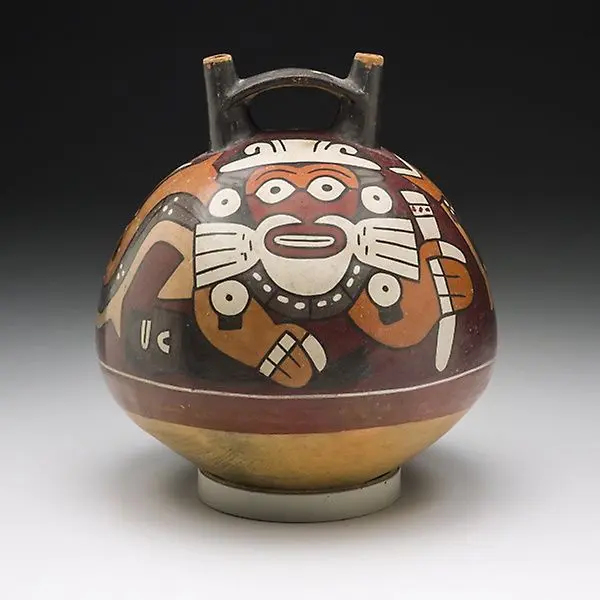
- Nasca culture, south coast of Peru. The British Museum holds a mould-made, painted ceramic panpipe from Nazca, dated between 100 BC and AD 650.
- Cahuachi, the Nasca ceremonial center. Excavations in 1994–1995 found a group of 27 ceramic panpipes (antaras) left as an offering in a temple. A 2009 acoustic study in the Revista Española de Antropología Americana concluded that their production technology was “muy avanzada” and that their tuning was not careless.
- Moche culture, north coast. Museo Larco dates its panpipe pieces to the period between AD 1 and 800 and notes that Moche scenes show musicians playing panpipes in ceremonies.
- Chimú and Chancay cultures. The Metropolitan Museum of Art holds a silver vessel shaped as a panpipe player (Chimú, 1350–1470 CE) and a silver miniature panpipe (Chimú or Chancay, 1300–1470 CE).
Did the Incas play the pan flute?
Panpipes were played in the Andes many centuries before the Inca Empire, but the museum pieces we could document come from Nasca, Moche, Chimú and Chancay, not from objects identified as Inca. Ohio State’s guide dates the siku in the archaeological record to “pre Hispanic times” without naming the Incas. When a souvenir, a video or a playlist calls a specific instrument “Inca”, it is fair to ask what that claim is based on.
If your interest is the Inca world itself, Cusco is the place to see it in person, from the Qorikancha temple to the terraces of the Sacred Valley. Our Cusco City Tour visits Qorikancha, Sacsayhuamán, Q’enqo, Puca Pucara and Tambomachay, with departures at 9:00 or 13:00.
Plan your trip with context: Machu Picchu Peru Tours runs its Machu Picchu and Sacred Valley departures with guiding in English, Spanish or Portuguese, so the history behind each site is explained in your language. See our tours in Cusco.
How is a pan flute made, and how is it played?
A pan flute is made by cutting pipes to different lengths, closing them at the bottom and binding them side by side, from longest to shortest. A longer pipe produces a lower note and a shorter pipe a higher one, so the set of lengths decides the instrument’s scale. Britannica notes that the pipes are tied with wax or cord.
Andean panpipe makers have worked with cane for generations, and ancient makers also used clay. The Nasca panpipe in the British Museum was mould-made and painted, and the Cahuachi study describes a manufacturing process precise enough to control tuning.
Playing in pairs: the ira, the arka and the hocket
The siku is traditionally played by two people because each half holds only part of the scale. The ira player sounds one note, the arka player answers with the next, and the melody emerges from the exchange. Ohio State’s guide calls this alternating technique hocket, a term also used in European music for melodies shared between voices.
To produce a sound, the player rests the top of a pipe against the lower lip and blows across the opening, not into it. Breathing has to be coordinated with the partner, which is why siku players rehearse together. Ohio State notes that siku ensembles “incorporate experienced and inexperienced players”, so newcomers learn inside the group.
Peruvian pan flute music and pan flute bands
Traditional siku music, the Peruvian pan flute music heard in the Andes, is commonly performed in groups, particularly in sikuri ensembles. A siku ensemble is called a sikuri group (sikuris, in plural), and these groups play as large ensembles in which ira and arka players alternate notes. When people search for a “Peruvian pan flute band”, sikuri groups are the traditional form, while modern Andean bands may mix sikus with guitars and other instruments.
A major documented setting for sikuri music in Peru is the Festividad de la Virgen de la Candelaria in Puno, inscribed by UNESCO in 2014 on its Representative List of the Intangible Cultural Heritage of Humanity. The festivity is held each February, with Quechua and Aymara participants and thousands of dancers and musicians. Groups compete to take part: in October 2023, 82 sikuri groups competed in Lampa, Puno, in the regional contest that qualified 31 of them for the 2024 Candelaria.
Sikus also appear in huayno, one of the most widespread genres of Andean music. Ohio State lists guitar, charango, bombo, kena (quena) and siku pipes among the instruments of a huayno ensemble. For a reference point in Peruvian music history, El Cóndor Pasa, by the composer Daniel Alomía Robles (1871–1942) of Huánuco, was declared Cultural Heritage of the Nation in 2004.

Instruments you will hear alongside the pan flute
| Instrument | Family | What it is | Source |
| Siku / zampoña | Wind (panpipe) | Andean panpipe in two halves, played in alternation | Ohio State University CLAS |
| Quena (kena) | Wind (notch flute) | Single end-blown tube with finger holes | Grinnell College |
| Charango | Strings | Small Andean string instrument, part of huayno ensembles | Ohio State University CLAS |
| Bombo | Percussion | Large drum used in huayno ensembles | Ohio State University CLAS |
| Guitar | Strings | Common in huayno ensembles | Ohio State University CLAS |
Where to hear or see the Peruvian pan flute
| If you want to… | Look for… | Why |
| Hear large siku ensembles | Sikuri groups at the Candelaria festivity in Puno, in February | UNESCO recognizes the festivity, and sikuri groups compete to take part |
| Hear the siku with other Andean instruments | Huayno performances | Huayno ensembles combine siku, quena, charango, bombo and guitar |
| See ancient panpipes | Pre-Columbian collections such as Museo Larco in Lima | Museo Larco documents Moche and Nasca panpipes, and The Met holds Chimú pieces |
| Understand the Andean setting of the music | Inca and colonial sites in Cusco and the Sacred Valley | The places, communities and history behind Andean culture are explained on site by a guide |
Is the siku protected as Peruvian cultural heritage?
Yes. The siku and the sikuri tradition were declared Cultural Heritage of the Nation by Peru’s former National Institute of Culture (Resolución Directoral Nacional N.° 824/INC), as the Ministry of Culture recalls in its 2023 resolution. That 2023 resolution, published in El Peruano on August 20, 2023, declared the promotion and safeguarding of the siku to be of interest to the culture sector and described it as part of the cultural corpus of the Andean region “desde tiempos prehispánicos”.
For travelers, this recognition is a reminder that the siku is a living community practice and not only a souvenir. Sikuri groups have their own leaders, repertoires and festivals, and the meaning of the music belongs to the people who play it.
The pan flute, Cusco and the Andes on a cultural trip
A trip to Cusco puts the pan flute in its Andean setting, even though the largest siku festival takes place in Puno. Cusco was the capital of the Inca Empire, and towns of the Sacred Valley such as Pisac, Ollantaytambo and Chinchero show Andean community life alongside Inca sites. Music is not a fixed part of any tour, so if hearing live Andean music matters to you, mention it when you request your itinerary.
These are the Machu Picchu Peru Tours trips that best connect with the cultural side of this guide:
- Cusco City Tour: leaves at 9:00 or 13:00 and returns between 14:00 and 18:00, visiting Qorikancha, Sacsayhuamán, Q’enqo, Puca Pucara and Tambomachay, the core sites of the Inca capital.
- Sacred Valley connection to Machu Picchu, 2 days / 1 night: combines the Sacred Valley with Machu Picchu, with guiding in English, Spanish or Portuguese. Before you go, read about the history of Pisac and the Ollantaytambo ruins.
- Machu Picchu Full Day: a one-day trip from Cusco to Machu Picchu and back, with guiding in English, Spanish or Portuguese.
If you would rather focus on the valley without Machu Picchu, see the Sacred Valley of the Incas tour. In Chinchero, a town known for its textile weaving, you can learn about the town and its history or join our picnic with llamas in Chinchero.
Cusco sits at about 3,400 meters (11,150 feet) above sea level, and Puno is higher. Read our guide to altitude sickness in Cusco before you plan the first days of your trip. This content is informative and does not replace an individual medical evaluation.
Build a cultural itinerary: Tell us your dates and interests, from Inca history to Andean music, and Machu Picchu Peru Tours will suggest a Cusco and Sacred Valley itinerary with guiding in English. Compare our Machu Picchu packages.

Frequently asked questions
What is the Peruvian pan flute called?
The Peruvian pan flute is usually called the siku, the zampoña or the antara. Siku is the traditional Andean name, zampoña is the Spanish word, and antara is a Quechua name, according to Ohio State University’s Andean music guide. All three names refer to the same family of Andean panpipes, traditionally made of cane.
Is the pan flute originally from Peru?
No single country can claim the pan flute. Britannica describes panpipes as widespread in Neolithic and later cultures, from Melanesia to pre-Columbian South America. Peru does have well-dated ancient examples, such as Nasca ceramic panpipes from between 100 BC and AD 650, which place it within an ancient and well-documented Andean panpipe tradition.
What is the difference between a pan flute and a quena?
A pan flute has many pipes, each producing one note, and the player blows across the top of each one. A quena is a single cane tube with a U-shaped notch and finger holes, held vertically, and the player changes pitch by covering the holes. Both are traditional Andean wind instruments and often play together in huayno ensembles.
Why do two people play one siku?
The siku is split into two halves, the ira and the arka, and each half holds only part of the notes. Two musicians alternate notes to build a single melody, a technique called hocket. Ohio State’s Andean music guide describes the ira as the leader with fewer pipes and the arka as the follower with more pipes.
How many pipes does a Peruvian pan flute have?
The number of pipes varies with the size and tuning of the siku. What stays constant is the split: the ira half has fewer pipes than the arka half. A pan flute with about 20 pipes in a single row is more likely the Romanian nai, which Britannica describes with about 20 pipes tuned to a seven-note scale.
What instruments did the Incas use?
The museum evidence reviewed for this guide documents Andean panpipes from cultures older than or contemporary with the Inca, such as Nasca, Moche, Chimú and Chancay, rather than pieces identified as Inca. For specific Inca instruments, look for museum records or archaeological reports that name the Inca period before trusting a label.
Where can I hear Peruvian pan flute music in Peru?
A major documented setting is the Festividad de la Virgen de la Candelaria in Puno, held each February and recognized by UNESCO, where sikuri groups compete and parade. Siku also appears in huayno performances across the Andes. In Cusco, live music is not guaranteed on any tour, so ask about options when you plan your itinerary.
What are the traditional musical instruments of Peru?
Traditional Andean instruments of Peru include the siku or zampoña (panpipe), the quena (notch flute), the charango (a small string instrument) and the bombo (a large drum). Ohio State University lists them, along with the guitar, as the usual instruments of huayno, one of the most widespread genres of Andean music.
See the Andes behind the Peruvian pan flute
The Peruvian pan flute is more than a souvenir sound: it is the siku, an Andean instrument shared across Peru, Bolivia, Chile and Argentina, played in pairs and ensembles, with documented archaeological examples dating back roughly 2,000 years on Peru’s south coast. Knowing the difference between a siku, an antara and a quena changes how you hear Andean music on a trip.
If you want to see the places and communities behind that music, Machu Picchu Peru Tours can put together a Cusco, Sacred Valley and Machu Picchu itinerary with guiding in English. Tell us your travel dates, the number of travelers and your hotel category, and we will send you a personalized proposal.